There are two types of kings who dwell both above and below. They are the old and the new. The dichotomy is not a metaphorical device, rather it’s real in a psychological sense. It is understood as a symbol, much as the Soul, Spirit or Mother are understood both Symbolically and as ‘lived experience’. The Old King pertains to that which no longer serves and is in need of renewal. It relates to Saturn, who devours his children, and traditions-out-grown. Sometimes the Old King is missing, a phantom, and an absent father, in this case there is a power vacuum, segregate and proxy rulers. Other times he is a tyrant and an over baring task-master, ever present in our waking lives, a dictator, and a big brother.
Our current Old King had once been new. The way mainstream history describes it, during the Age of Enlightenment and its subsequent Industrial and Technological Revolutions people were rising from the “irrational” (systems based on myth, story, and belief) and entering the “rational” (systems based on method and proof). They call these movements “Great leaps.” The New King had much promise. He created cities, established universities and democracies and fought for individual rights. One could say, he even got us to the moon. But as the years proceeded things changed. His industries grew to great proportions and pollution choked the earth. For every New King becomes, one day, old.
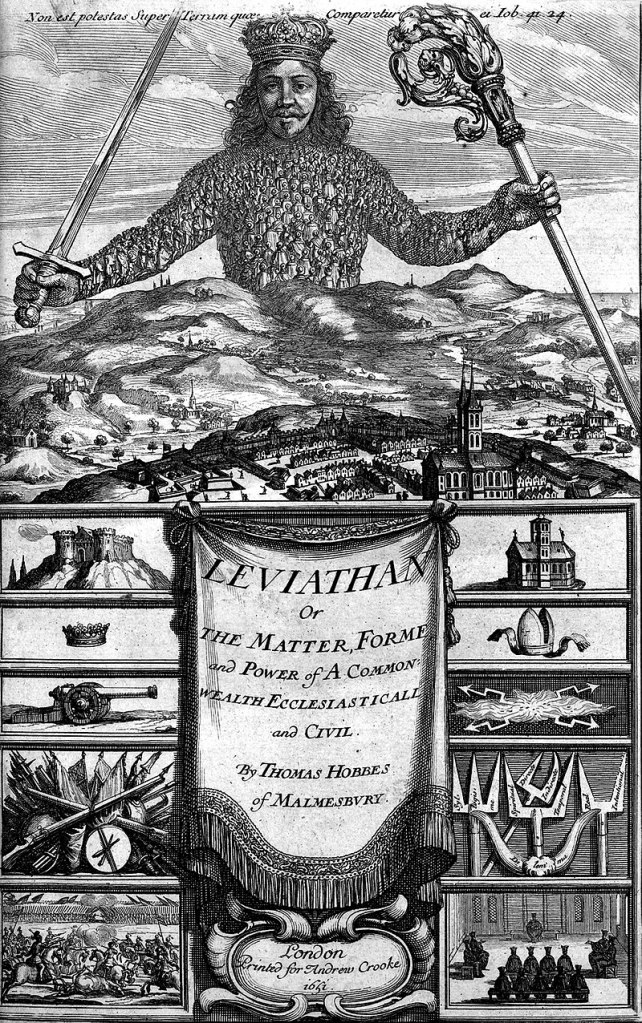
Our current world dilemma comes to mind, when the “uninhibitedly desirous” rulers spoil the land and exploit the people. Have the corporations and oligarchs become Saturnian titans, who are ripe to be overthrown? His likeness is that of earth and no longer sky, he has made himself, through Divine-Right a God upon the land. And if this seems outmoded or fantastical to our sensibilities consider a King who is no longer a single person but persons and is able to print his propaganda upon currency through his 10,000 arms. In what God do American’s trust? A Leviathan. A corpus of individuals working, breathing, living and dying together; a summum malum a fear of death which serves to bind them. While the summum bonum the truly free life is left to the outsider and the digested.
A New King updates the old ways. Jung shows that the New King, or the filius regius (Royal Son), is identified with Mercurius (Jung MC, para 473). Mercurius represents many things, including adaptability, inconsistency, and speed. He is “above and below” and the joiner of the “sun and the moon” (para 12, 44). In short, he is the holder of opposites, something that the old king cannot do, since he has isolated himself. And without being tongue and cheek about it, the opposites held, relates not to force but acceptance. Watching the back and forth of yin and yang is the play of the Dao; its not the war of light and dark. Therefore, the New King is also a Queen. The new King does not lead he follows. Every Valley lies below and therefore draws the water. The grass bends in the wind, the old stiff tree is blown over. Time turns for the New King, it does not “progress.”
THE DETHRONMENT OF CRONUS
Zeus grew to manhood among the shepherds of Ida, occupying another cave; then sought out Metis the Titaness, who lived beside the Ocean stream. On her advice he visited his mother Rhea, and asked to be made Cronus’s cup-bearer. Rhea readily assisted him in his task of vengeance; she provided the mustard and salt, which Metis had told him to mix with Cronus’s honeyed drink. Cronus, having drunk deep, vomited up first the stone, and then Zeus’s elder brothers and sisters. They sprang out unhurt and, in gratitude, asked him to lead them in a war against the Titans.
The war lasted ten years but, at last, Mother Earth prophesied victory to her grandson Zeus, if he took as allies those whom Cronos had confined in Tartarus.
After the three brothers had held a councel of war, Hades entered unseen into Cronus’s presence, to steal his weapons; and while Poseidon threatened him with the trident and thus diverted his attention, Zeus struck him down with the thunderbolt.
Expert from Greek Myths by Robert Graves
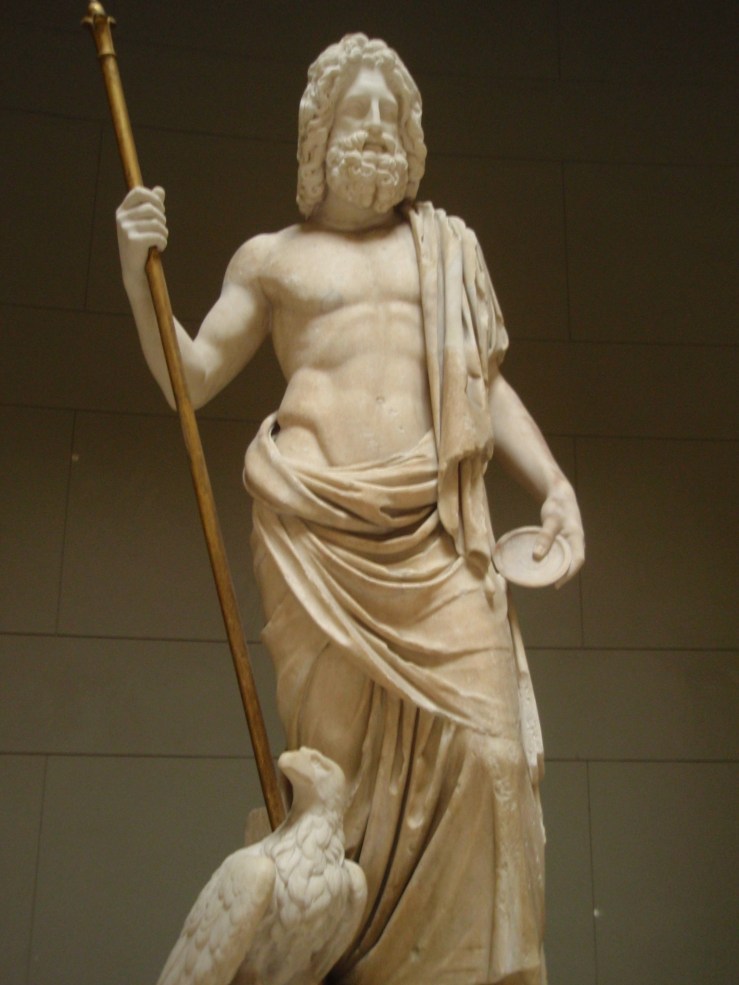
In the beginning, we find that the young Zeus lives on Earth with the Goddesses, the mother figures. These figures have had their children taken from them, consumed. These are the invididuals of summum bonum (children!), made hard and crule through a rule of summum malum (fear!). They, the Mothers, hide him in a cave suggesting both the all-encompassing nature of the Mother-Archetype and the cthonic ignorance of childhood. Here the feminine element takes an important role. They keep him in Nature’s Garden as long as possible. The women are those who educate the New King with native philosophy. And, victims themselves, they are also willing to aid him in a quest for vengeance. By making him cup-barer, they bring him into close proximity to the Old King. The cup is another feminine symbol, known as the “vessel” in alchemy, suggesting again that the New King is doing the transforming work of individuation and is in touch with his anima. Does it suprise, that out of touch with the feminine, the Old King Cronus fails to recognize his own son as cup-barer.
Rhea helps Zeus by providing the mustard seed and the salt. This gesture works in two ways: first the mother is accepting the independence of her son, a process vital to any individual’s well-being, and second that she, as her husband’s wife knows the hidden cure for him. In Paracelcus’s Tria Prima sal is a symbol of body; it’s also the “Son” in the Holy Trinity (Father, Holy Spirit, Song). Thus, Christ is sometimes known as Sal sapientiae, the salt of wisdom. Also “it represents the feminine principle of Eros which brings everything into relationship” (Jung: MC para 321) Here I am reminded of the Beatrice in Dante’s Divine Comedy; how it is through her grace that he is saved from the “dark woods,” or the shadow of reality.
The mustard seed represents humility and individuation. It is from a simple, insignificant seed that an entire plant will spring. Matthus 13:31 “He put another parable before them, saying, “The kingdom of heaven is like a grain of mustard seed that a man took and sowed in his field. It is the smallest of all seeds, but when it has grown it is larger than all the garden plants and becomes a tree, so that the birds of the air come and make nests in its branches.” Meanwhile, the Preponderance of the Small in the I-Ching (62. Hsiao Kuo);
The flying bird brings the message:
It is not well to strive upward,
It is well to remain below.
Great good fortune.
Spiritual greatness always begins in humble beginnings. Not only do countless fairy stories bare witness to this, but anecdotal evidence of persons who inherited wealth verses those who acquired it through hard work. Back to our story, Zeus while being the humble water-boy is able to approach that king. And with these two ingredients, mustard seed and salt, we have a predominant symbol of transformation, which takes place right within and unbeknownst to the old, blind King. Once he ingests this, the chemical reaction will begin and he will throw up the missing siblings.
From a collective standpoint, these consumed children are those who service the Old King and his rule of summum malum. They are the inner-proletariat of society; those who work “with the man,” though they truly despise and fear him. They are the people driven by the social mores, go to the movies, and fight in the wars set out by the Old King. Today (as in the past), these mores are the platitudes of society and the drives (often for material success, but sometimes valor in the face of violence). By forcing him to vomit, Zeus is liberating the people who have been consumed by these dominate mores of the collective shadow, freeing them from the destructive habits and consequences that the Old King brings about and shepherding them to a “new light.”
After Zeus is reunited with his siblings the war against the titans begins. They are told to liberate Cronus’s enemies from Tartarus to help them. This is another symbol of those that live under the adversity of the Old King. One could call these enemies in Tartarus the outer-proletariat, the marginalized and suppressed sections of society. Here we are liberating all the pieces that hitherto had been suppressed by the worn out King-Image. Zeus literally finds all of the psychological material that Cronus had ignored and unties it against him.
When Zeus and his siblings defeat Father Time, they do not end their transformation. Instead it is the beginning of the Olympians. Zeus, being the one to strike and kill Cronus, becomes King. He is the All-Father who is different than the paternal god that came before him. Unlike Cronus, he is interested in human affairs, particularly those of his off-spring. He mediates disputes and aids those who are righteous and good. The rise of Zeus to the throne thus parallels a rise in male conscious to the concerns of those around him. This is the Father-Image on its light side rather than shadow side. It recognizes its responsibility and relates to the feminine around him.
WHAT HAPPENS TO THE OLD KING?
After the arrival of the New King, there are essentially there are two possibilities for the Old King. Either the Old King capitulates to the new governance or he is slain, like Cronus, with a lightning bolt. The latter option is rather straight-forward and resembles the French Revolution. In this case, the old system is too burdensome for the new system to incorporate and is therefore eradicated. However, there is a second option that of the Old King living on through the New King. This option is provided for in various myths as well. Von Franz points out that “the mythologem of the transformation of the old king into his young successor was more characteristic of Egyptian theology” (His Myth, pg 179). In fact, Jung uses the example of “Amon, the Father-god, [who] unites himself, for instance, with Thutmosis I, and then, lives on after his death as ‘Horus, the son of Hathor’” (MC, para 329ff).
The Egyptian myth provides a hopeful outlook. In the case of our modern society, this will resemble a letting go of the scientific biases and a blending of those elements with what the New King’s summum bonum or evangelium (in the strict “good news” sense of the word). Compare this with the old scientific methodologies which tell us that there is nothing left for us to do; “piteously it is seen from another planet that the king is growing old, even before he sees it himself: ruling ideas, the ‘dominants’ change, and the change, undetected by consciousness is mirrored in dreams” (Jung MC para 504). We can choose to see this king from “another planet” and recognize that his dream has become a nightmare. The helplessness of science to solve the worlds problems and political recklessness are the result of his holding on for his insecurity of letting go.
If the New King can, like Horus, contain his Father then the Old King can rest at ease. By living through the New King, the Old King also can achieve the immortality that he had been so obsessed with. That is, through a relinquishing of his powers, those powers are offered to the continuous development of humanity. In this regard, the God-Image, at least in its temporal-sense, lives on ubiquitously. The New King in his temperance, will understand that there is nothing fundamentally wrong about the current system, it has simply run aground and is no longer viable. He will thus adapt and update them.
BIBLIOGRAPHY
Jung, C.G. (1953). Two Essays on Analytical Psychology. New York, NY. Pantheon Books
Jung, C.G. (1963). Mysterium Coniunctionis. New York, NY. Pantheon Books
Von Franz, Marie-Louise. (1975). His Myth in Our Time. New York, NY. C.G. Jung Foundation for Analytical Psychology
Bly, Robert (1990). Iron John. New York, NY. Addison-Wesley Publishing Company
Graves, Robert (1957). The Greek Myths. New York, NY. George Braziller, Inc.
Harding, Esther (1947). Psychic Energy. Princeton, New Jersey. Princeton University Press
 Rickey Lee Bauman