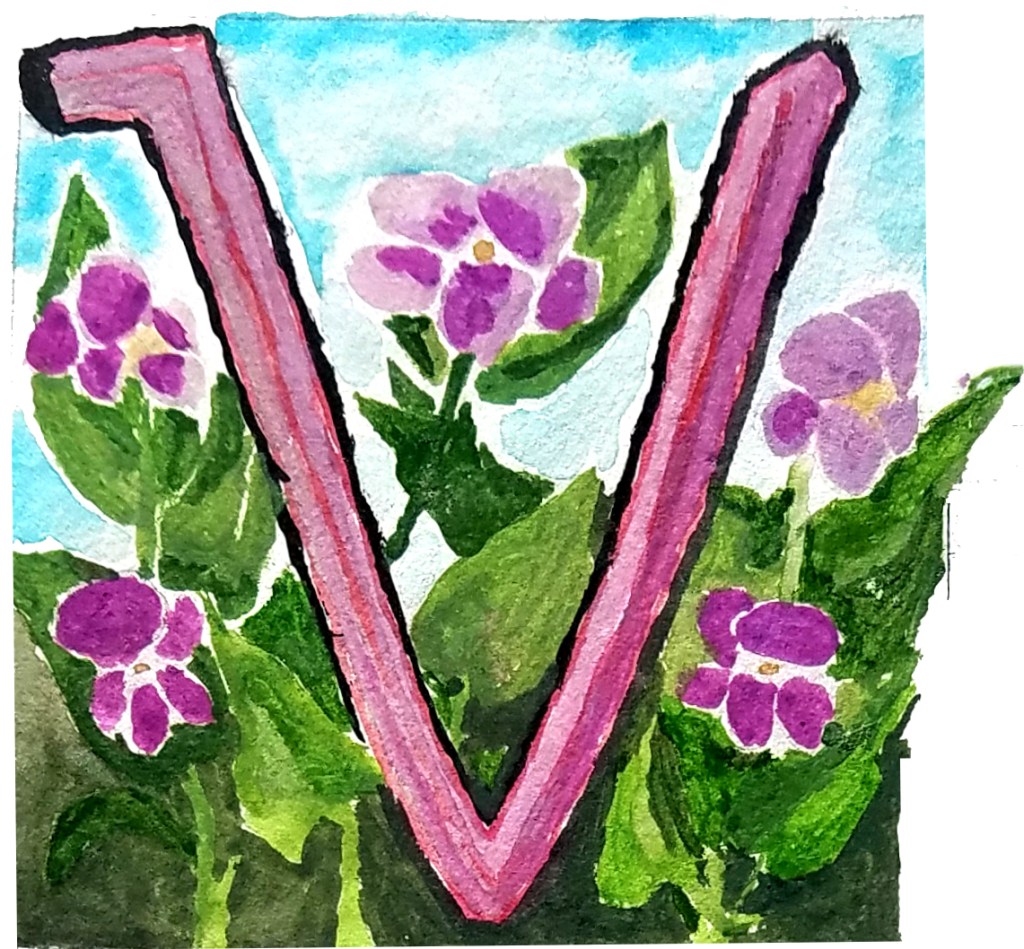
IOLET: A Fairy Tale of Love Lost.
“You lost Cadmus!” Violet shouted before falling to her knees laughing. “And…” She exasperated her words, “it’s your turn to go fetch the arrows!”
He cracked a smiled, dropped the bow, and, with a playful intention to punish her, pulled her with him to the soft grass. There they tussled about in a neat fit of hysteria until a sudden silence was brought upon them by a mutual kiss.
From that day onward, they were inseparable. A bond had formed between them that was fit either for alters or fairy tales.
But the gods had planned it differently. One day while slumbering like babes beside a vast fresh water lake, Cadmus was visited by a strange dream. He saw the wavering outline of a distant mountain. It shook and then rumbled. A great jet of smoke followed by streams of lava blasted suddenly from its peak.
He woke and turned to his lover, “I’ve been called by Fate. I have to go. I don’t know why. But I must.”
Sleepily she wanted to respond, “Can’t you just stay? Why leave now, when we are closest together?” But wisdom halted her. Intuition bespoke that some strange and unmovable destiny was afoot. Whether she answered urgently or solicitously, the two were bound to separate. In the end, she said, “I will miss you.”
On the gray morning of his departure, they stood ceremoniously on the banks of the lake. He kissed her and placed in her hand a magic blue stone, saying, “My love will remain as constant and precious as this stone. Wait for me.” She took it but could not answer. Solemnly she clasped his green cloak over his shoulder and fastened his spear, Obelus, to his belt. Each then turned away slowly and walked their separate way notwithstanding a second glance back.
Soon he was alone in the woods. The day light shone through the little spring leaves and birds sang their joyous songs. No sooner he left the peaceful town, when he began to feel free and, even, a little happy. So is the effect of adventure upon the young.
As midday approached he came to a river. Perhaps it was the berries he’d eaten or the warm weather, but he didn’t feel rushed, and rather than swim across presently, he decided to take a short break. Soon this break brought drowsiness and he decided that sleep was preferable to a cold swim. The river crossing could be postponed until tomorrow.
Wrapping himself in his cloak, that night he slept beneath an old and magic oak. And at the hour when the waves of time stretch out, a Goddess approached wrapped in a silvery gown. From the woodwork of the trees she walked over to him, saying, “wake up, Cadmus. There’s no time to sleep. Tonight, to help you on your path I will teach you to see without your eyes.”
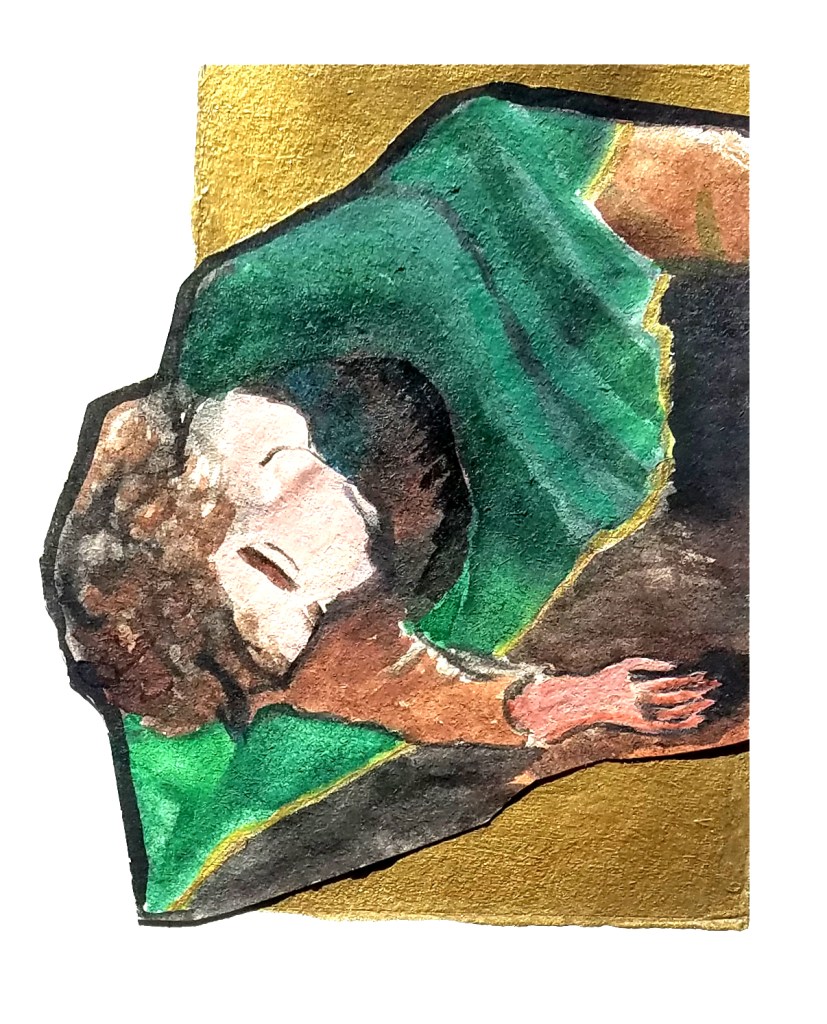
He rose wearily form his bed of leaves and walked to the river’s edge. He did not know how, but a new and strange power coursed under his skin. Under the moonlight he metamorphosed into an owl. He jumped into the night air and took winged flight. How awesome it felt to beat his own wings, gain altitude, and watch as the river and forest shrank below him.
While the singing birds slept he took his nocturnal flight on the cool winds. A full moon hung high over the horizon and the morning star passed through the great dipper. He followed the river diligently as it wound toward the mountain. Until he reached a cascading waterfall.
The crashing water produced a mist that rose up and curled its foggy arms toward him. Cadmus scanned with his owl eye and spotted a feminine figure dancing in the pools. More like a swift kite then an owl he pitched his wing and glided down in a spiral. Coming to land on a perch near the water’s edge, he spied her. It was the water nymph, Undine, frolicking as she does every month under that particular moon.
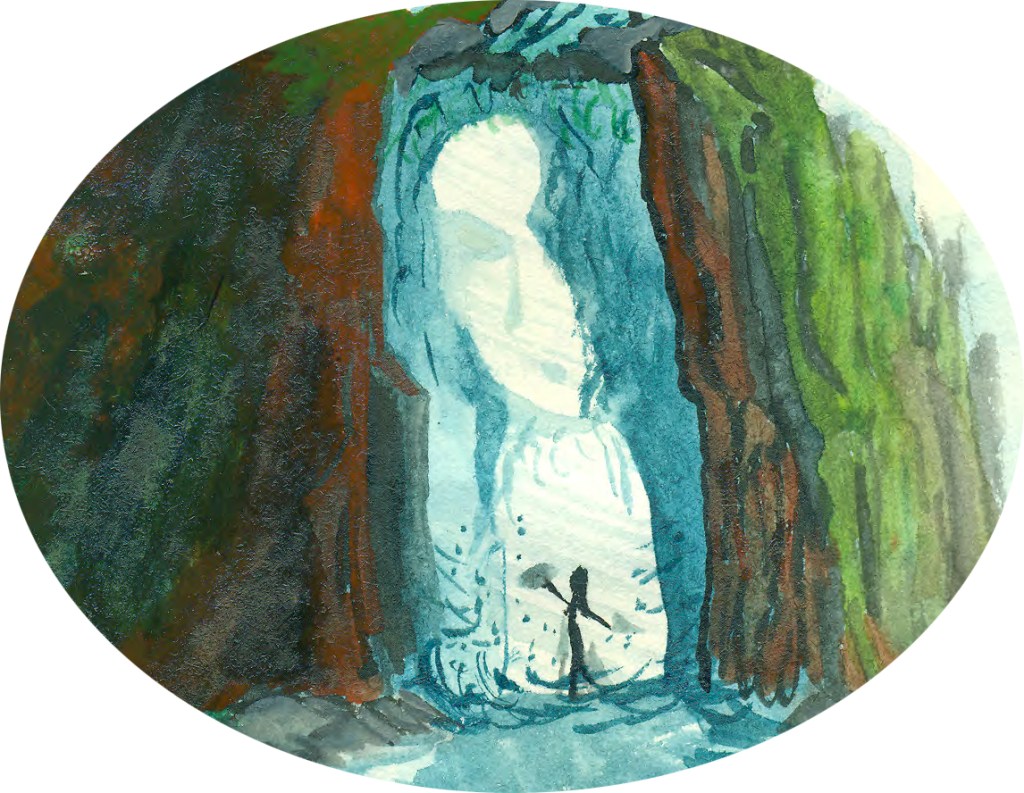
Transfixed by nature and buffered by pride, he turned into a man and walked to the water’s edge. She noticed him but did not quit her dance. Instead as a master of her tricks, she incorporated into her movements a seductive gesture that was meant as an invitation. Such watery provocation was all it took, without a second thought he set aside his spear and unclothed and danced and swam with the beautiful naiad.
Only at sunrise with her sleeping beside him, was his folly laid bare. As Lancelot had been, when he was tricked by lovelorn Elaine, Cadmus found an illusion washed away. With the realization that his purity was lost, self-hatred shook his soul. Then, gazing on her sleeping face, he forfeited to a subtle law of nature and resigned himself to his mistake. He kissed her one last time and then fled.
He soon found himself in a dense forest where a canopy of ancient trees blocked out the light of day. Cadmus struggled to navigate through the dark foliage and avoid hidden thorns of brambles. Finally torn all up, he called out for nature’s aid. A firefly buzzed around him as he waited. One by one from shaded gullies and woodland pile more fireflies gathered around. Could this be his aid? Soon a busy swarm glowed so bright he was able to see ten feet around and it was a movable light which followed him wherever he hiked.
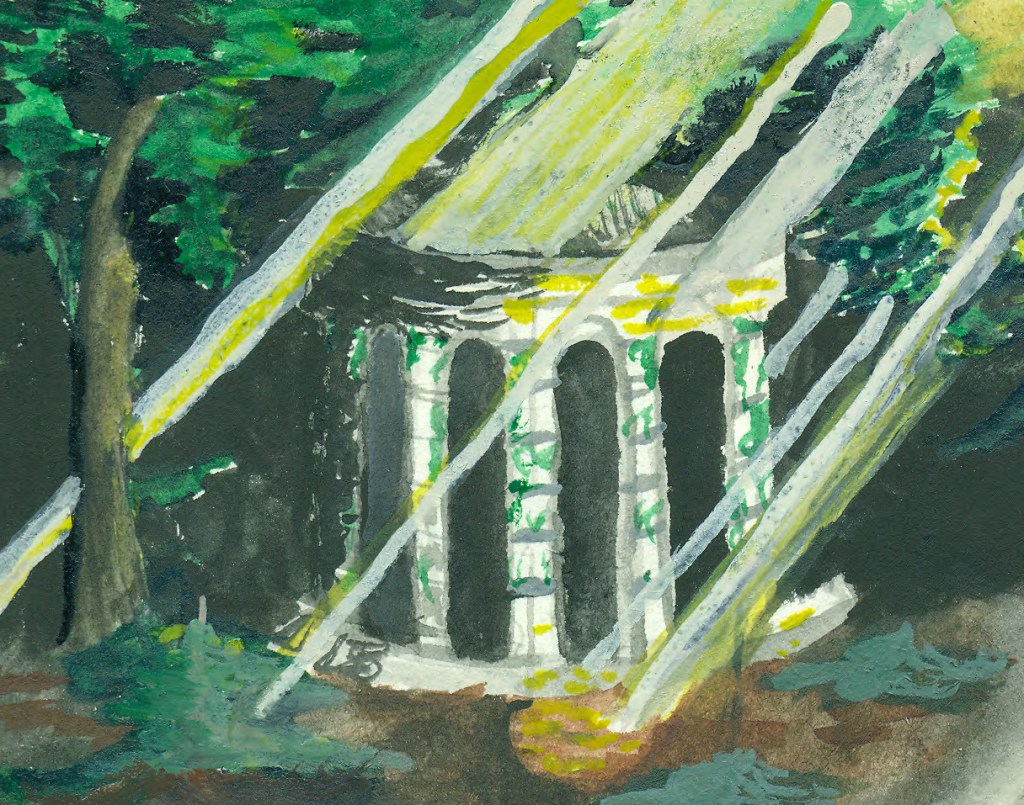
By some misguided erudition, he came to an abandon tomb. At its entrance he paused to smell the sodden air; a hesitation that seemed to vex his helpful will-‘o-the-wisps. They buzzed into the sepulchral space and took point, leading him, and revealing a vaulted chamber. Discarded burial urns and decomposed clothes littered the floor. And then at the back there was the double-sarcophagi of a knight and a maiden. Cadmus moved forward and read the inscriptions on the wall. “Tristan and Isolde, lovers unto death.”
How horrible to see love in such a state. A tragic, reminder to warn all. This had borne into him a doubt that gnawed at his heart the rest of the day. The only remedy he could find for this feeling was urgency. He began to make haste.
From bipedal feet he bent down on all fours. His palms turned to pads and nails into claws. He was now a nimble gray wolf and bound through the underbrush with a furry of strides. Up the sloop toward the mountain he ran. The trees thinned to ferns and the ferns to grass. He had reached the highlands. It was night again but there were no stars in the west. Though his eyes could not see in definition, his wet nose sensed a thunderstorm. The upper reaches would be impassable.
Lucky for him, perhaps, he found a lodgers hut, a friendly glow emanating from its windows. “I will stay only until the storm passes,” he reassured himself. After one firm knock on the door, a jovial and bearded man opened up with a rush. He promptly held up a jar of whiskey – the best in the land – and invited Cadmus in for a glass.
Cadmus put a few back before unwinding his tongue and told the story of his lover back in town. And as he thickened the story with sweet words his host’s interest began to flag. The mountain man only laughed and admitted that though he enjoyed a good tale of love he most preferred tales of lust. And so with his own stories, he stacked atop his hunter’s bread a cut of sausage.
Cadmus rose his heavy head off the table to see that his host now slumbered by the fire. He walked to a window and flung it open. The storm had past. He could see the stars in the dawning sky. A breeze from the east carried with it the smell of violets. Only his lover’s name carried with it the same power that once her vestige had.
Rather ingloriously he turned into a sure-footed mountain goat. The steepest slopes were like stairs to him now. And so he made quick time to the finishing line. Climbing to the very peak, above him now hung only the great vaulted sky. Now again as a man, holding Obelus upright, he looked out on all cardinal directions.
A sure gale picked up. The giant cumulus clouds broke apart before his eyes. And a blinding light radiated first from the east and then in all directions. He shaded his eyes with his forearm and watched as a great triple halo grew vast in the space between here and the horizon. And then—how bizarre and unworldly—at the center of this light, as if held by the very hand of God, streaks of violet unfurled. The pleasant awe that accompanies bliss is beyond words, suffice it must, however, that a mystery was revealed thus to him.
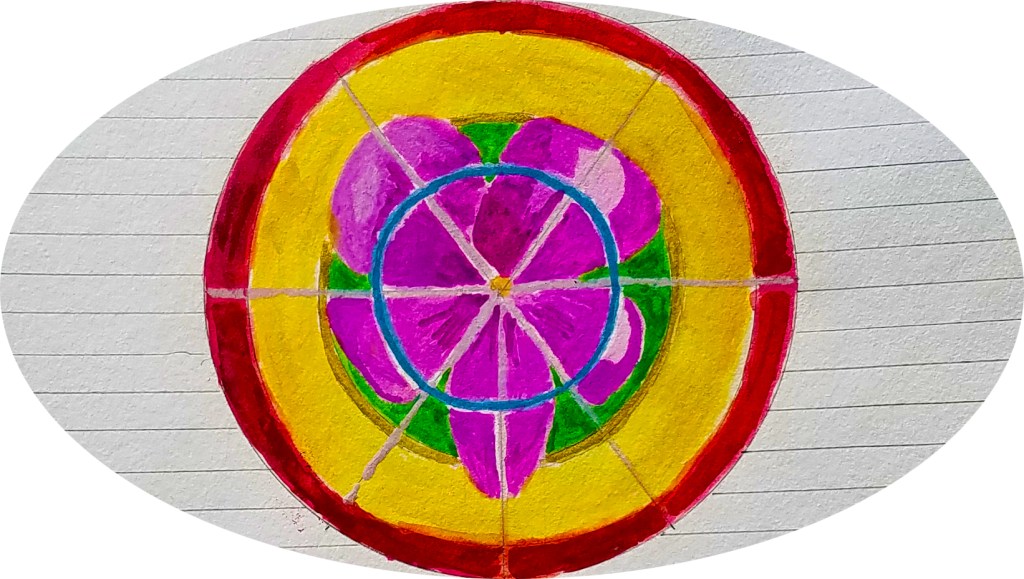
A bell suddenly tolled, shattering the light. Cadmus opened his eyes. He lay under the same old oak that he slept under at the beginning of his journey. The bell continued to ring off in the distance, it was the town bell. He roused himself wearily. How long had he been asleep? The budding leaves of spring were gone. Only the dark green leaves of late summer clung to the branches. He brushed woodland soil from his hair and clothes. Rubbing his face, his hand found a beard. How long had he been asleep?
Walking on well-known paths he arrived in town. Nobody was about and nothing stirred. All was broken, crumbled and mute. Only a robin sang near the fountain. “What has happened here?” Cadmus interrupted. The robin then sang the saddest tune he’d ever heard. The robin sang of the dragon’s attack on the night of the Midsummer weddings.
“And the people? Where have they gone to?”
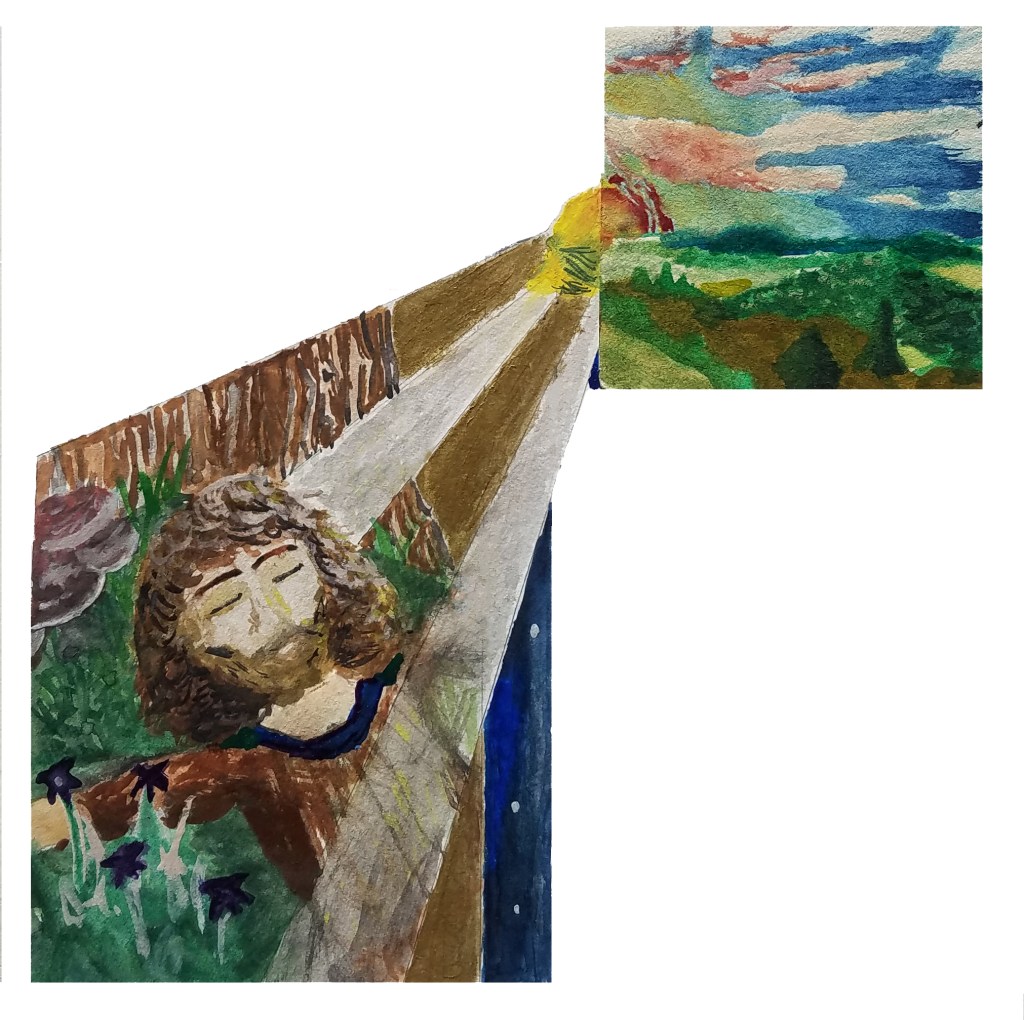
The robin shook his head sadly, “All of them have either been killed or taken captive.” Cadmus resigned himself to deep mourning. “There is one human left,” the Robin continued, “the priest, he rings that bell every morning, hoping to bring refugees back from the desolation. Go to him, he will surely be glad to see you.”
More like a carpenter than a man of words, the priest was found at the wood mill. Cadmus was met generously by the lone man who had survived the dragon. Given the circumstances one would assume their meeting was of joy, as it was perhaps on the priest’s side, but overshadowed by the great sense of loss now dawning on him, he sulked and began to weep.
“There now, good hunter. We will get through this. With you now, our efforts will be doubled! Every morning I ring the town bell, fetch water from the well, gather lumber, plane the bark, saw the pieces to fit, and rebuild. It would suffice a small army of workmen to do the task that must be done, but it’s only me… and now you.”
Cadmus was despondent. The priest put his mirth in check. “I’m sorry for your losses my friend. But you will find that in working hands our troubles fall away.”
He worked to rebuild the town right through summer and into fall. Not once it seemed did his heart grow any lighter. But, it was true, the labor, at least, had the power to take his mind off the memories of Violet, which now plagued him like a ghost.
One day, he was to collect mushrooms near the forest’s edge, when he came to the lake where he and she had once played. But it too had changed. The lake was barren, its waters all dried up. This horrible sight was enough to break his already dying heart. Like a specter sorrow had now won him over.
All magic was lost. Like a man possessed he wandered the woods. There was no more shape shifting under his skin and in his bones. A pack of wolves or a chance bear would be enough to take him down. But he didn’t care. Death, he thought, could be his cure. Finally he came to a cliff, where he decided to end his life. He peered over its edge with tears streaming down his eyes. Then like a volcanic explosion, a hidden energy surmounted from within.
When words fail before the scene of some self-made tragedy, he did what many would do and fell to his knees. There he prayed, until he formed his new reason to live and dedicated himself to finding and rescuing Violet from the dragon.
That night, no images came to him in his sleep, no great gods. But when he woke the next morning to his surprise he found a snake coiled around his leg.
“What are you doing here?” he asked.
“I am cold blooded, as you know, and these fall nights are getting s-s-so cold. I only s-sought out the warmth of your body. I mean you no harm.”
“Fine. But, excuse me, I must be off. I am in search of a dragon.
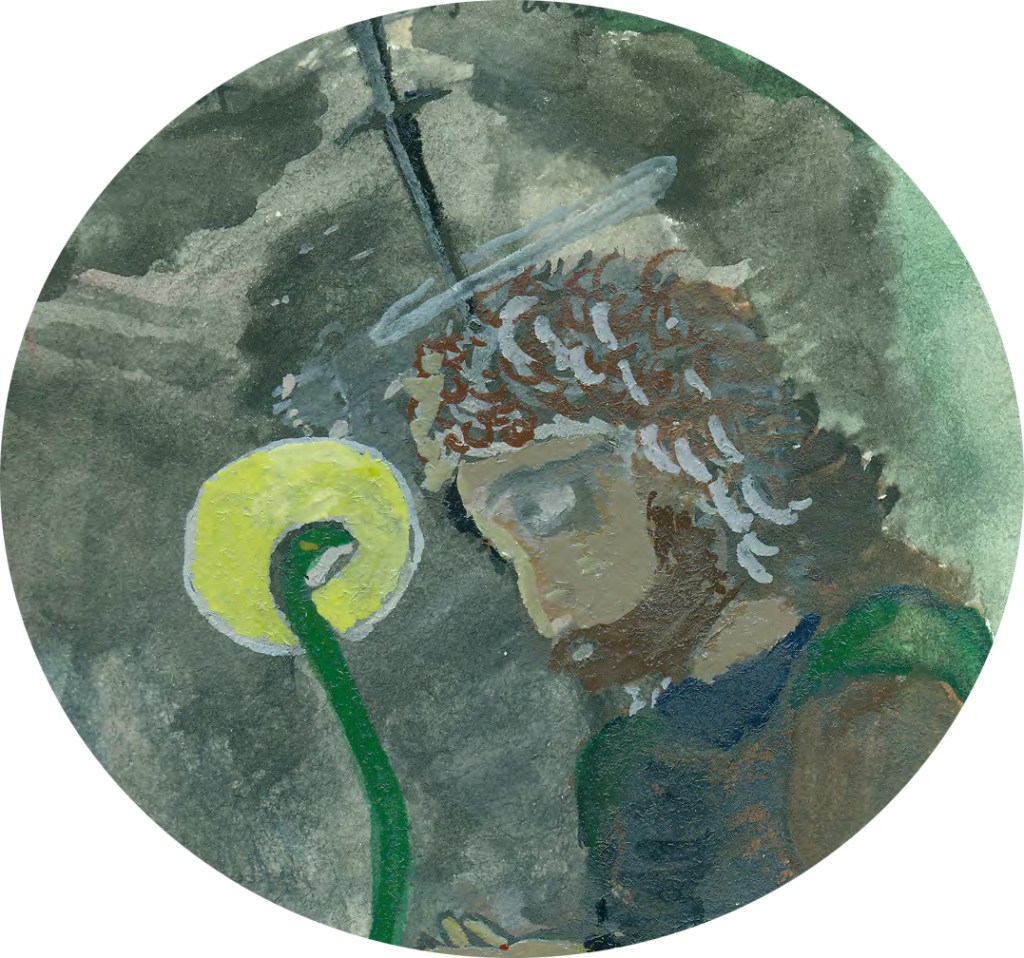
The snake slithered with delight. “I will agree to tell you the location of the dragon, if in return, you’d feed me just a little blood. I am thirsty and who knows the next time I’ll have the opportunity to catch a rat.”
With the tip of his spear, Cadmus pierced his left palm and let blood drip down into the snake’s mouth.
“I am no pet to these vampiric delights, Snake, so don’t expect it again.”
“And I am no fox, so here is my end of the bargain, human. My es-steemed cousin, the Dragon, can to be found burrowed up in north, at an abandon quarry by the sea.”
Cadmus set off at once, taking with him the last of the ripe fruits from the trees; apples and grapes. Some would call it luck, others his determination, but he came to the north and the sea with little ado. And at the quarry, which formed a half-bowl he climbed down to the seaside, where he discovered the dragon’s den in tidal sea cave.
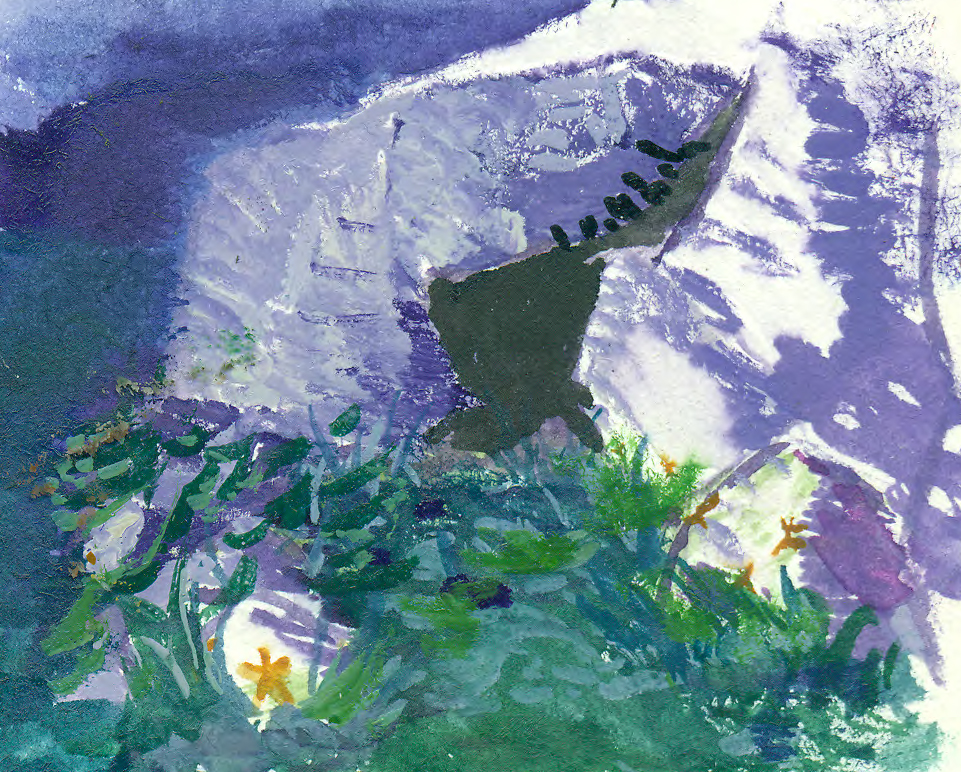
He entered, knee deep in seawater, his spear drawn. Waves beat ceaselessly against the rocks filling the cavern with a briny mist. An unknown source of light from within the grotto produced an eerie efflorescence of teal and purple. He waded in slowly as the dragon lurked in the darkness.
Like lightning the dragon struck first gnashing its teeth and whipping its tail. Cadmus deflected and parried. And then he lunged but found no mark. They exchanged attacks, flurry after flurry. Each maneuver met its counter and every defense stood. It became not a test of skill but endurance (and woe is it: a dragon’s endurance is prodigious). His doom was inevitable. In a dire moment, his arms weary, Cadmus found he could thrust no more. The dragon rose up. Cadmus slouched back. And as the dragon pounced to seize its triumph, he fell back, lifting and levering Obelus to the earth behind him. Cadmus had allowed gravity and centrifugal force do the rest. The point of that long spear found its mark and plunged deep into the dragon’s chest, stopping only once it had torn the purple-black heart asunder.
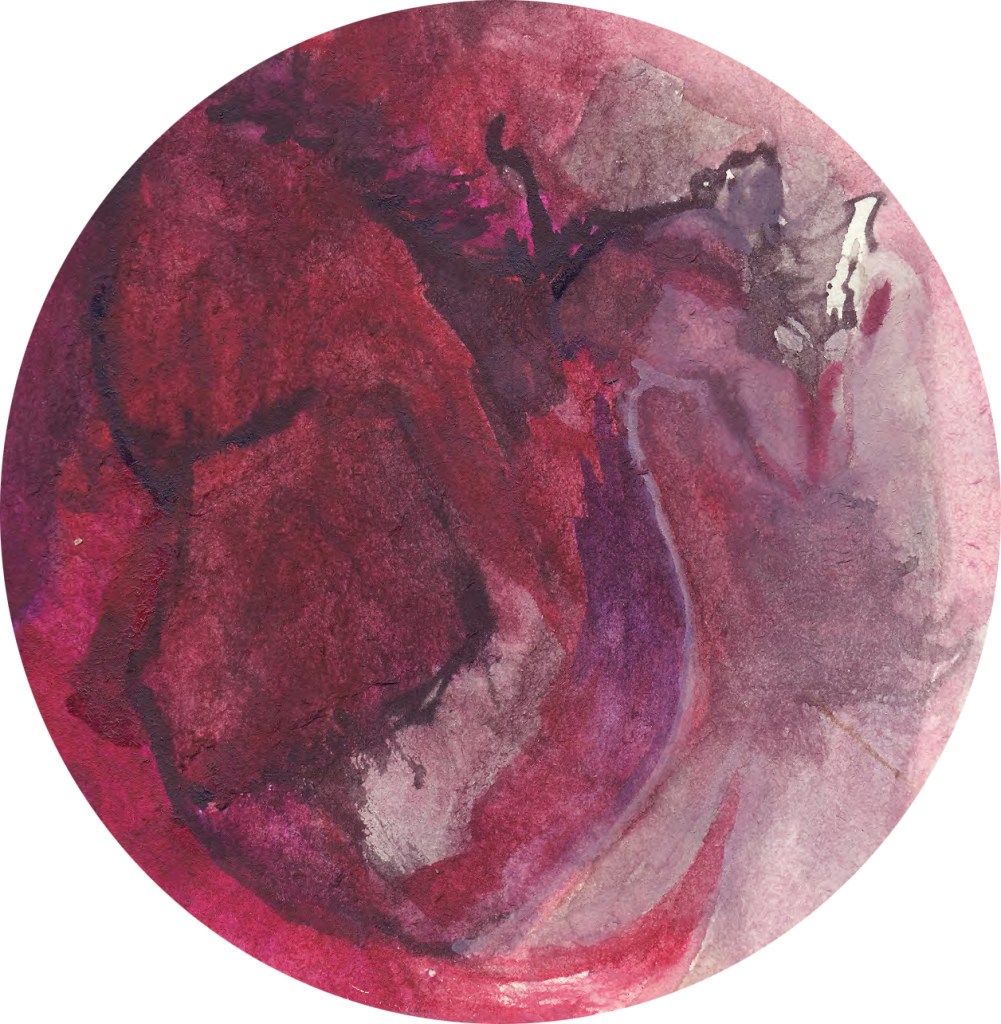
The dragon slain, Cadmus rushed to the captives who met him with a group outpouring of joy. So many compliments but he couldn’t hear Violet, where was she? He cut through the crowd, searching her out, until coming out the other side he found only a mound of glittering gold.
But no gold could console him. He had fought and won. But without her, no victory, great or small, held meaning. Then a man, who he knew as Cygnus, stepped forward. With a mark of compassion, he placed his hand on Cadmus’ shoulder and said, “I sympathize with your loss. But she is gone my friend.” He held out the lucky stone. “I was with her during the attack. Before joining arms of her fate, she gave this to me to give to you. Bury it, friend, where you have your fondest memories.”
So the captives, each carrying a great load of gold, returned to their homes where they rebuilt their lives: markets, monuments and all. And on the banks of the lake, Cadmus buried the stone. Tears in his eyes, he watched as the sun sank behind the silent, cold mountains and turn the clouds brilliant gold and pink.
 Rickey Lee Bauman